

Short answer
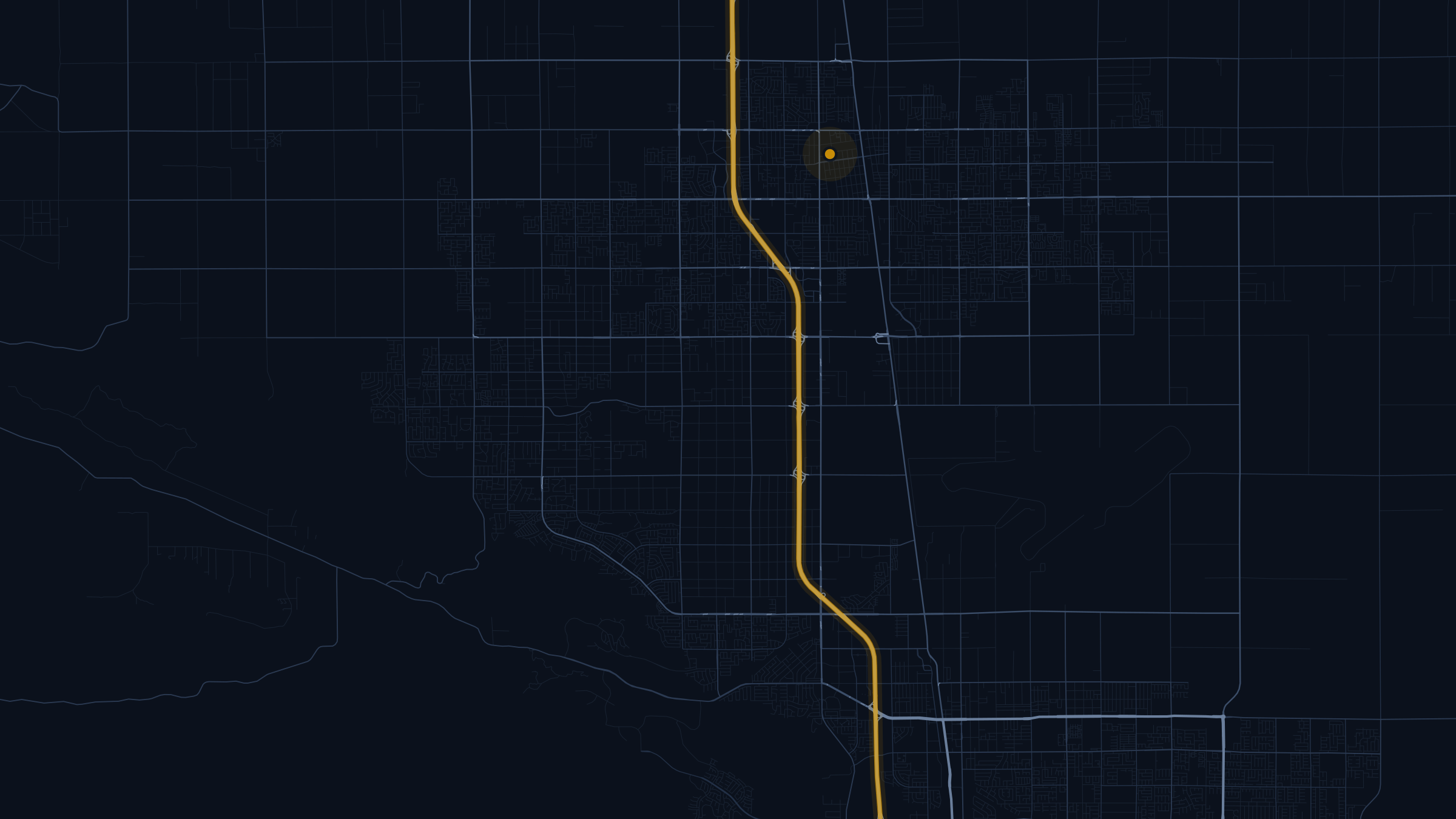
If your car breaks down on Highway 14 (CA-14) in the Antelope Valley, get as far right as you can, turn on your hazard lights and stay buckled in unless there is no safe place to wait. Call 911 if anyone is hurt or the car is in a traffic lane. Then note your direction and the last exit you passed, such as northbound past exit 43, Avenue J, and call for a tow.
What should you do in the first five minutes?
- Get as far right as you can. If the car still moves, take the next exit and stop on a city street. If you can’t reach an exit, pull onto the right shoulder, as far from the white line as the shoulder allows. Use the left (median) shoulder only if there is no other choice.
- Turn on your hazard lights and leave them on, even in daylight. Since 2026 they are what tells approaching drivers to move over (see below).
- Decide whether to stay in the car. The California Driver Handbook says to stay inside with your seat belt on unless there is no shoulder or safe area. Get out if the car is smoking or burning, or if it is stopped where traffic could hit it.
- If you get out, get away from it. Use the door away from traffic, take everyone with you, and wait behind the guardrail or well up the embankment. Never stand between the car and traffic, or directly behind it.
- Work out exactly where you are before you call (the next section shows how).
- Call for help. Don’t change a tire on the traffic side of a freeway: ask for flat tire service or a tow to a safer spot. If there was a crash, see accident recovery.
Call 911 first if
- anyone is hurt
- the car is smoking or on fire
- the car is stopped in a traffic lane, or partly in one
- there is no shoulder and you cannot get out of the way of traffic
- something on the road is a danger to other drivers
Don’t try to push a car out of a freeway lane.
Why do your hazard lights matter more since 2026?
Since January 1, 2026, California’s Move Over law (Vehicle Code 21809, as changed by AB 390) covers more than police cars and tow trucks. It now applies to any stopped vehicle showing hazard lights or warning devices such as cones, flares or reflective triangles.
Drivers coming up behind you must move to a lane that is not next to you if that is safe and legal, or slow to a reasonable speed. The law sets a fine of up to $50.
- Your hazards trigger the rule. A dark car on the shoulder gives other drivers no legal signal.
- Place triangles or flares only if you can do it without walking into traffic.
- Not everyone will move over. Stay on the side of the car away from the lanes, and move over yourself when you pass someone stopped.
How do you describe where you are on the 14?
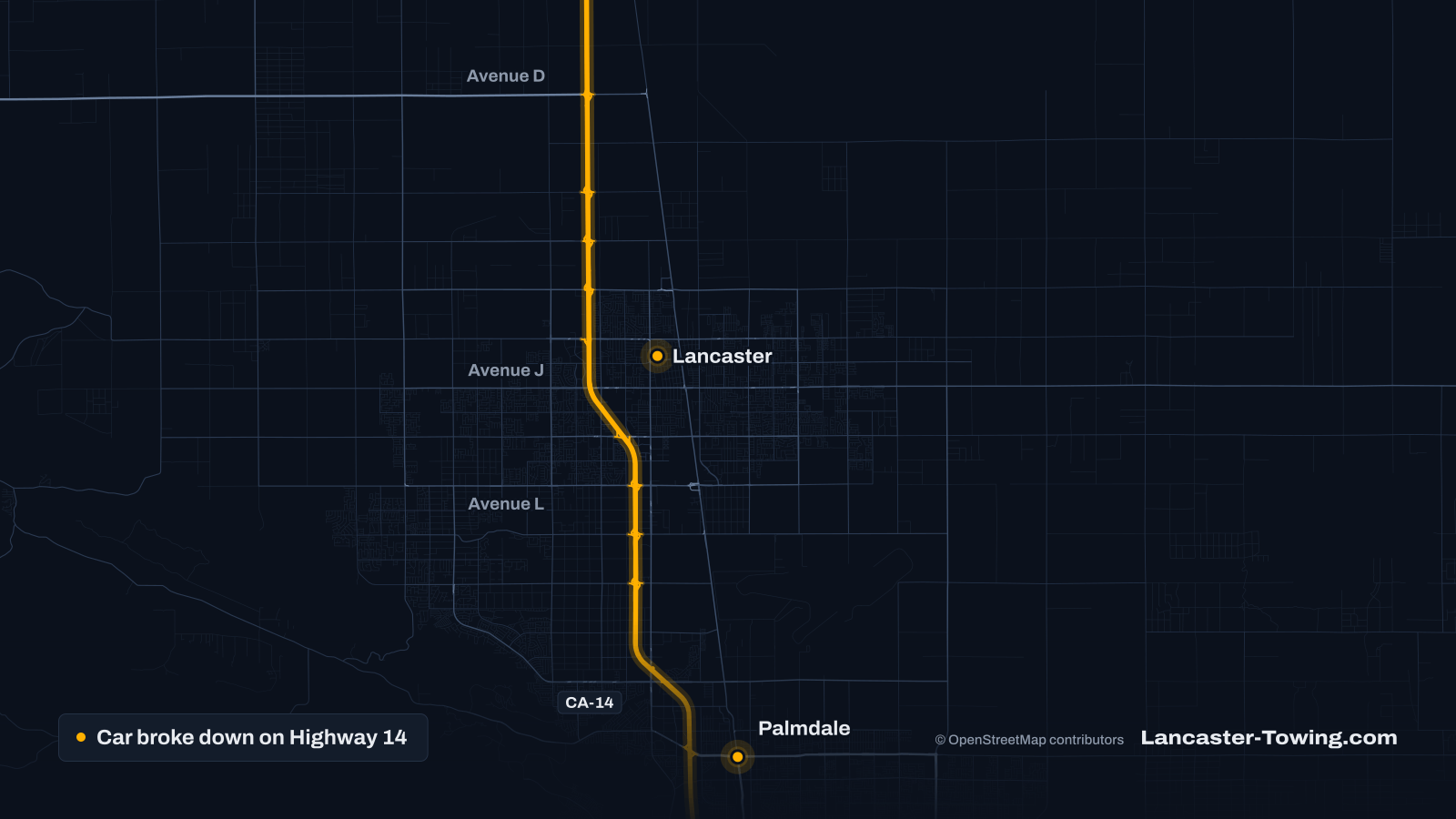
Four details find you on CA-14:
- Direction. Northbound heads toward Lancaster, Rosamond and Mojave. Southbound heads toward Palmdale, Santa Clarita and Los Angeles. The two sides are separate roads, so this matters most.
- The last exit you passed, by number and name. Exit numbers go up as you head north.
- The next exit, if you saw its sign.
- A landmark. An overpass street name, a mile marker, or the Lamont Odett Vista Point, which Caltrans places south of Avenue S, overlooking Lake Palmdale.
Between exit 35 (Palmdale Boulevard) and exit 49 (Avenue D), the freeway is signed as both CA-14 and SR-138. If you see a 138 shield, you are still on the 14.
Say it like this: “Highway 14 northbound, right shoulder, past exit 42, Avenue K, before Avenue J. Gray Toyota RAV4, hazards on.”
GPS helps too. The request form has a button that adds your phone’s coordinates. Give the direction anyway: coordinates alone may not show which side of the freeway you are on.
CA-14 exits through the Antelope Valley
| Exit | Exit name | Area |
|---|---|---|
| 55 | Rosamond Blvd | Rosamond (Kern County) |
| 52 | Avenue A | Last exit before the Kern line |
| 49 | SR-138 West / Avenue D | North of Lancaster, toward Gorman |
| 46 | Avenue G | Lancaster (north side) |
| 45 | Avenue H | Lancaster |
| 44 | Avenue I | Lancaster |
| 43 | Avenue J | Lancaster |
| 42 | Avenue K | Lancaster |
| 41 | Avenue L | Lancaster |
| 40 | Avenue M | Lancaster |
| 39 | Avenue N | Between Lancaster and Palmdale |
| 37 | 10th Street West (southbound) | Palmdale |
| 35 | SR-138 East / Palmdale Blvd | Palmdale |
| 33 | Avenue S | Palmdale |
| 30 | Angeles Forest Hwy | South of Palmdale |
| 27 | Soledad Canyon Rd | Acton area |
| 24 | Crown Valley Rd | Acton |
Exit numbers and names come from Caltrans’ SR-14 exit list, last updated in 2018. The City of Lancaster lists the Avenue G, J, K, L and M interchanges among those it is improving, so ramp signs can differ from older lists. Give the exit sign you actually saw.
The full list of what a dispatcher needs is in what to tell a tow dispatcher.
Stopped on the 14 and ready to call for a tow?
Call for towing help (661) 555-0123Who responds to a breakdown on Highway 14?
- The CHP, even inside city limits. Under Vehicle Code 2400, the California Highway Patrol has primary jurisdiction on state freeways, including through Lancaster and Palmdale.
- CHP Antelope Valley Area patrols about 30 miles of SR-14, from Acton to the Kern County line (CHP). Its office is at 2041 W. Avenue I, Lancaster.
- CHP Antelope Valley Area non-emergency line: (661) 743-6060.
- Near I-5, the SR-14 interchange is in the CHP Newhall Area.
- North of the county line, Rosamond is in the CHP Mojave Area, (661) 823-5500.
- Off the freeway in Lancaster, city streets are patrolled by the LA County Sheriff’s Lancaster Station.
If the CHP orders a tow, you can usually still choose: CHP policy tells officers to honor a request for a specific tow company or motor club unless that is impractical, for example when the car blocks an off-ramp.
Be wary of a tow truck nobody called. Vehicle Code 22513 makes soliciting a tow at a disabled vehicle a misdemeanor unless the owner or driver summoned the truck, or law enforcement or a public agency requested it. Ask who sent them.
For a tow off the freeway, see emergency towing.
Is there free roadside help on the 14?
Possibly, but don’t rely on it.
- Metro Freeway Service Patrol (FSP). LA Metro says the service is free to motorists. Its trucks change flats, jump-start batteries, give up to a gallon of fuel, or tow you to a CHP-designated safe spot off the freeway, not to a home or shop. Metro lists hours of 6 a.m. to 7 p.m. on weekdays and 10 a.m. to 6:30 p.m. on weekends. Dial 511 and say “Motorist Aid” (SoCal511).
- The catch. Metro’s published FSP map, dated 2015, shows SR-14 patrol beats from the Santa Clarita area up toward Palmdale. Coverage in Lancaster is not confirmed, so line up a tow as well.
- Call boxes. In 2019 Metro’s board approved removing most LA County freeway call boxes and keeping them only on a short list of rural roads. SR-14 and SR-138 were not on it, so don’t count on finding one.
How long can you leave a car on the shoulder?
Not long. California allows stopping on a freeway only in limited cases, such as when a vehicle is disabled and the stop is unavoidable (Vehicle Code 21718). Under Vehicle Code 22651, officers can remove a vehicle that blocks traffic or creates a hazard, and one left more than four hours on a freeway when it cannot move under its own power.
Arrange the tow while you are there. If you must leave, take your registration and valuables and note the exact spot. If the car is gone when you return, the towed and impounded car guide explains how to find it.
Wind, dust, heat and snow on the 14
Wind and blowing dust. The National Weather Service office in Los Angeles/Oxnard issued 20 to 41 Wind Advisories a year for the Antelope Valley from 2016 through 2025, by a count of its archived products. Since 2023, March has had the most advisories and warnings, and July and August none. A typical advisory calls for gusts to around 50 mph, warns that blowing dust can cut visibility, and flags hard driving for big rigs and motor homes.
In May 2013, CBS Los Angeles reported, citing the CHP, that a dust storm caused about a 20-car pileup and closed SR-14 in both directions for about four hours. If you can’t see, slow down, and if you must stop, get completely off the road.
Heat. At Lancaster’s Fox Field, July and August average highs are about 98°F, and the station averages about 36 days a year at 100°F or more (NOAA 1991–2020 normals). A stalled car heats up quickly: the National Weather Service notes that a parked car can go from a safe temperature to a dangerous one in a few minutes, even on an 81°F day. Carry water, and never leave a child or pet in the car. If the engine overheated, see what to do when your car overheats.
Snow and ice (rare). On December 26, 2019, the NWS issued a Winter Storm Warning for the Antelope Valley calling for 3 to 6 inches of snow on the valley floor and warning that travel on Highways 14 and 138 could become very difficult to impossible. NBC Los Angeles reported that parts of the 14 in the Palmdale and Lancaster areas were closed the next morning.
Check before you go. Caltrans QuickMap shows closures and incidents. Caltrans highway conditions are also available by phone at 1-800-427-7623.
More questions
Should I stay in my car if it breaks down on the 14 freeway?
Usually, yes. The California Driver Handbook says to stay inside with your seat belt on unless there is no shoulder or safe area. If you do get out, use the door away from traffic and wait behind a guardrail or well up the embankment.
Who do I call if my car breaks down on Highway 14 in Lancaster?
Call 911 if anyone is hurt or the car is in a traffic lane. CHP has primary jurisdiction on freeways, even inside Lancaster; for non-emergencies the CHP Antelope Valley Area office number is (661) 743-6060. For the tow itself, call a towing service or your roadside plan.
How long can a broken-down car stay on a California freeway shoulder?
Not long. Under Vehicle Code 22651, officers can remove a vehicle that blocks traffic or creates a hazard right away, and one left more than four hours on a freeway when it cannot move under its own power. Arrange a tow while you are still there.
Does the Freeway Service Patrol cover Highway 14 in Lancaster?
That is not confirmed. Metro's published service map shows patrols on parts of SR-14 up toward Palmdale, not Lancaster. You can dial 511 and say 'Motorist Aid' to ask, but plan on calling a tow as well.
Do drivers have to move over for a car with its hazard lights on?
Yes, since January 1, 2026. California's Move Over law (Vehicle Code 21809) now covers any stopped vehicle showing hazard lights, cones, flares or reflective triangles. Drivers must move to a lane that is not next to it when safe and legal, or slow down. The law sets a fine of up to $50.
Sources and official resources
- California DMV, Driver Handbook: Safe driving (disabled vehicles on the freeway)
- California Vehicle Code 21809 (Move Over law)
- California Vehicle Code 21718 (stopping on a freeway)
- California Vehicle Code 22651 (vehicle removal, including the four-hour freeway rule)
- California Vehicle Code 2400 (CHP jurisdiction on freeways)
- California Vehicle Code 22513 (tow solicitation at a disabled vehicle)
- Caltrans: SR-14 exit numbers (sheet last updated 2018)
- Caltrans: 2020 Named Freeways, Highways, Structures and Other Appurtenances
- City of Lancaster: SR 138/SR 14 corridor interchange improvements
- CHP Antelope Valley Area (545)
- CHP Newhall Area (540)
- CHP Mojave Area (830)
- CHP Highway Patrol Manual 81.2, chapter 7 (tow requests)
- LA Metro: Freeway Service Patrol
- LA Metro: Freeway Service Patrol map (2015)
- LA Metro board report 2019-0239: call box system restructuring
- SoCal511: Roadside assistance
- NOAA NCEI: 1991–2020 monthly normals, Lancaster Fox Field
- National Weather Service: Heat safety for children and pets in vehicles
- NWS Los Angeles/Oxnard Wind Advisory, April 1, 2025 (IEM archive)
- NWS warnings and advisories for the Antelope Valley zone, 2016–2026 (IEM archive)
- NWS Los Angeles/Oxnard Winter Storm Warning, December 26, 2019 (IEM archive)
- NBC Los Angeles: Travel slows to a crawl on an icy 14 Freeway (December 27, 2019)
- CBS Los Angeles: Hazardous driving conditions in the Antelope Valley (May 29, 2013)
- Caltrans QuickMap